
We cannot say for certain that every culture has a story that could be considered Cinderella, but most cultures do. Anyone, regardless of culture, can imagine being mistreated by the people around them and dream of marrying into riches. We do not know with certainty what the first version of “Cinderella” is. Some point to the first version of Cinderella being a version told by the Greek geographer Strabo in 1st century BCE. This version, Rhodopis, is about an innocent slave girl in Egypt. An eagle steals her slipper while she is bathing and delivers it to the king, who declares that every girl in the land will try on the slipper until he finds the girl who it belongs to. When he finds Rhonopis, he marries her.
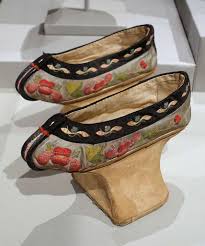
Another notable version often referred to as the first Cinderella is the Chinese story Ye Xian, which has been traced to 860 CE. This is the earliest record we have of the evil stepmother and stepsister characters in the story. It also has the first “fairy godmother” (or in this case, magic fish bones) that give her the ability to go to the festival/ball. This version of the story also explains why only Ye Xian could fit into the slipper; the slipper was enchanted to change in size so that it was always too small for anyone but its owner. Ye Xian has many more of the characters and plot points that we associate with the Cinderella story than Rhodopis, which is why it is considered by some the first Cinderella.
The story of Cinderella seems to have spread to Europe in 1634, with Italian poet Giambattista Basile’s Il Pentamerone. This book was a collection of fairytales, many of which are the oldest record we have of these fairytales. In Il Pentamerone, the story was known as Cenerentola. Cenere is Italian for ash, which means we have the first instance that I can find of the name “Cinderella” being a nickname referencing cinders or ash. Interestingly, the Cinderella character in this story is a princess, even at the beginning of the story.
 The next notable version of this story is the version that Disney’s Cinderella (1950) was based on: Charles Perrault’s Cendrillon. Written in 1697, Perrault also called this story “La Petite Pantoufle de Verre” or “The Little Glass Slipper”. This story is the first to make Cinderella’s slipper be made of glass. It is possible that this was a mistranslation from French to English, and the slipper in this story was really meant to be fur, but it is difficult to find proof of this. This version includes the two step-sisters, the stepmother giving permission for Cinderella to go to the ball before refusing to let her go, the fairy godmother, the pumpkin coach with mice horses, and the midnight curfew.
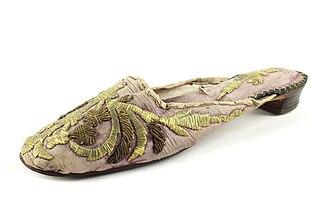 115 years later in 1812, the Brothers Grimm published their version of Cinderella, Aschenputtel. When people say that Disney’s Cinderella (1950) isn’t accurate to the original story, they are usually thinking of Aschenputtel. As we have proven already, this is not the original Cinderella. In fact, Disney’s Cinderella is one of their most accurate adaptations, because it is based on Cendrillon, not Aschenputtel. However, Aschenputtel and Cendrillon are very different stories. Like some older versions, in Aschenputtel, Cinderella gets her dress and shoes, not from a fairy, but from a plant—in this case, from the tree over her mother’s grave. Like many Grimm fairytales, Aschenputtel is, in fact, grim. Grisly, even. When the prince comes to the house and lets the stepsisters try on the slipper—not glass, but embroidered with gold and silver—the stepmother makes her daughters cut off their heel and toes to fit into the shoe. It is only because of the blood dripping from the shoe that the prince realizes this is not the girl he danced with at the ball.
Since the invention of movies, there have been a number of Cinderella stories. Looking at these movies, it seems that all it takes to be considered a retelling of cinderella is a mean stepfamily, a mistreated main character, and a class difference between the main character and her love interest. For more information on “Cinderella Story” movies, I suggest these videos: